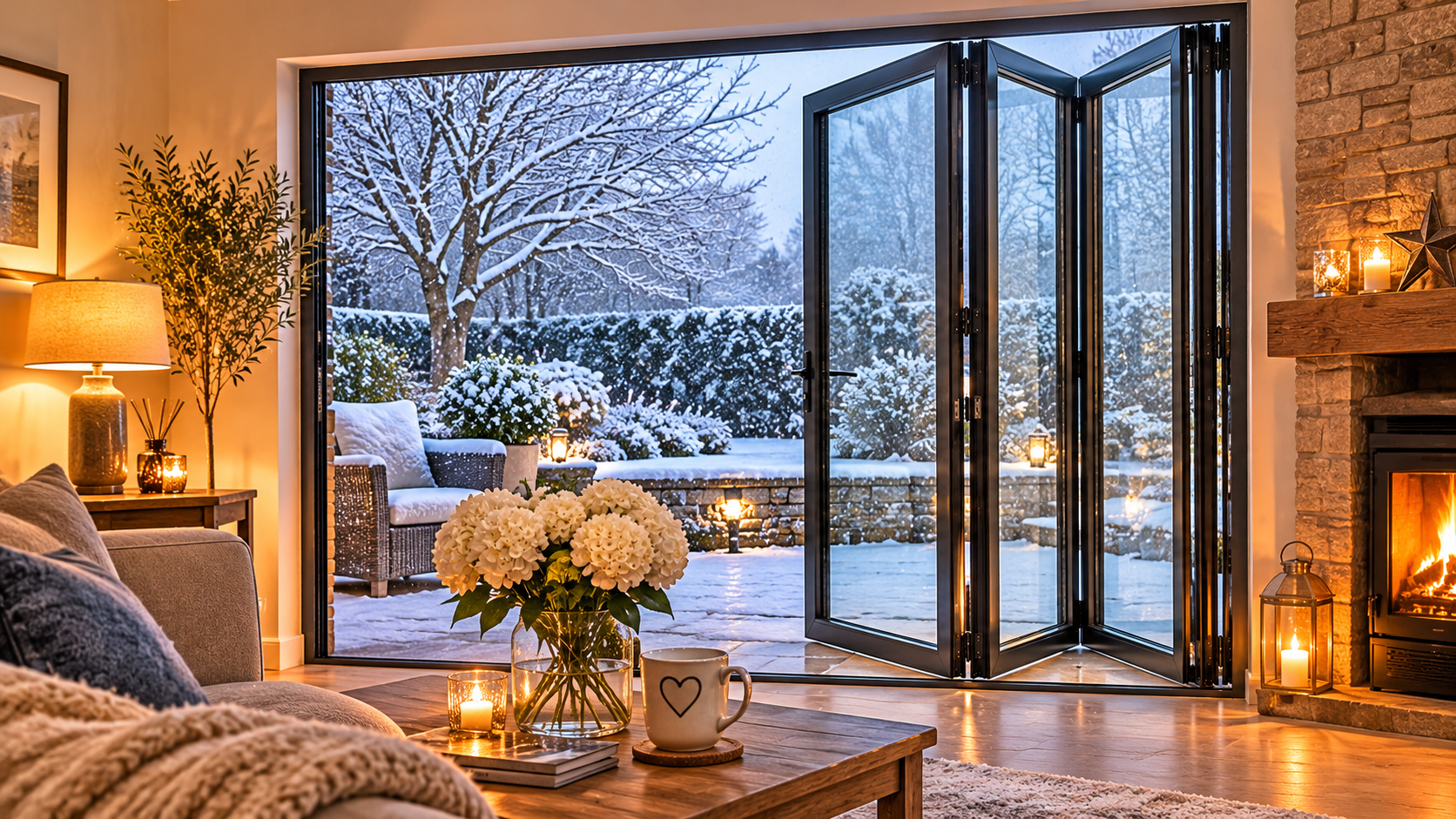
When homeowners start planning an extension or looking at replacing a brick wall with wide expanses of glass, one very practical worry almost always comes up first: “Will this turn my kitchen into a fridge in January—and a greenhouse in July?”
It is a completely fair question. If you remember older conservatories or 1990s aluminium patio doors that ran with condensation and felt freezing to the touch, it is natural to wonder how modern bifolding doors hold up against a British winter—or a sunny afternoon on a south-facing patio.
Here is how modern architectural bifolds keep your living space comfortable all year round, and what to look for when comparing quotes.
1. Keeping the Winter Cold Out
Glass makes up roughly 80% to 90% of a bifolding door, so thermal performance comes down to two things: what happens inside the metal frame and what goes into the sealed glass unit.
- The Thermal Break Inside the Frame: Bare aluminium conducts heat and cold, which is why old metal frames suffered from condensation. Modern architectural aluminium systems solve this by building a polyamide thermal break—a tough, non-conductive reinforced nylon barrier—right through the middle of the profile. It separates the cold outside aluminium from the warm inside aluminium, stopping cold from transferring into your room.
- Warm-Edge Spacer Bars & Argon Gas: Inside the double- or triple-glazed units, the gap between the panes is filled with argon gas (which is denser than air and slows heat loss) and sealed with warm-edge spacer bars rather than cold metal strips.
- Low-E Glass Coatings: A microscopic, invisible metallic coating on the inner pane reflects indoor radiator heat back into your kitchen while still letting low winter sunlight warm the room naturally.
- Compression Weather Seals: Quality bifolds use multi-chamber EPDM rubber gaskets around every panel edge.When you throw the main handle and engage the locks, the doors pull tightly into those seals to stop cold draughts whistling through on windy nights.
What to check on a quote: Look at the overall U-value of the complete door set (not just the centre-pane glass figure). A lower U-value means better insulation—modern UK Building Regulations require doors to meet strict thermal targets (typically 1.4 W/m²K or lower for extensions).
2. Preventing Summer Overheating
While winter warmth is usually the first concern, a wide wall of south- or west-facing glass can also trap a lot of solar heat in mid-summer. If your doors face the sun for most of the day, two upgrades make a noticeable difference:
- Solar-Control Glass: Filters out a high percentage of the sun’s infrared heat while keeping the glass clear and bright—stopping the room from overheating without making it feel gloomy.
- Integral Blinds: Sealed permanently inside the double-glazed cavity, integral blinds let you tilt or raise the slats to block harsh afternoon glare without cords tangling in the folding hinges.
3. Don’t Forget the Threshold
If your extension faces prevailing wind and driving rain, choosing a weathered rebated threshold rather than a completely flat internal track adds an extra weather seal along the bottom edge—helping keep cold floor-level draughts out during winter storms.